 The Question
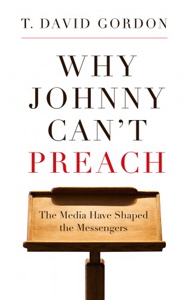
T. David Gordon believes that the majority of preaching today is rather poor, not so much in its content, but in its form as preaching. As a practitioner of preaching for decades and now as a professor of media ecology, Dr. Gordon is uniquely qualified to ask this question:
How has the movement from language-based media to image-based media and electronic media altered our sensibilities and how, in turn, has this change in sensibility shaped today’s preachers? (p.16)
The Answer
Gordon answers his question by starting with what a good preacher needs:
To preach the Word of God well, one must already have cultivated, at a minimum, three sensibilities: the sensibility of the close reading of texts, the sensibility of composed communication, and the sensibility of the significant. (p. 106)
He then spends much of the book explaining how visual and electronic media have chipped away at these three sensibilities in most seminary students before they even take their first course. Here, briefly, is a sample of what he means by the three sensibilities:
By the sensibility of the close reading of texts Gordon refers to the ability to appreciate a text not just for what it says, but for how it says it. For example, we read and preach John 3:16 and Romans 5:8 in exactly the same way, because we simply scan for information which is similar in both passages, but we miss the subtle differences in their form and therefore miss some of their significance and nuance:
The sheer pace of an electronic media-dominated culture is entirely too fast. Electronic media flash sounds and images at us at a remarkable rate of speed … We become acclimated to distraction, to multitasking, to giving part of our attention to many things at once, while almost never devoting the entire attention of the entire soul to anything. The close reading of texts would be an antidote to such a pace because such reading is time-consuming and requires the concentration of the entire person. (p. 50)
By the sensibility of composed communication Gordon refers to how the speed with which we are able to talk on the phone or write an email means we rarely take time to stop, compose, and order our thoughts in such a way that they make a clear point. This leads to preaching which is a transfer of information, but with no unity or order.
The handwritten letter requires composition: that one consider before one writes what one wishes to say, and how one wishes to say it. There is no “delete” key, and there are no emoticons to compensate for lack of clarity. One must say what one wishes to say clearly, so that the reader understands on the first reading. (p. 103)
By the sensibility of the significant Gordon argues that because we do not take time to read difficult works and because we speak and write so carelessly, we tend not to gravitate toward the truly important. Preachers then preach “how to” sermons or engage in thoughtless “culture wars,” but fail to uplift and behold the God who became a man.
Television, in contrast to poetry, is essentially trivial. Everything about it is trivial, and it is the perfect medium for the trivial. (p. 53) … The great seriousness of the reality of being human, the dreadful seriousness of the coming judgment of God, the sheer insignificance of the present in light of eternity – realities that were once the subtext of virtually every sermon – have now disappeared, and have been replaced by one triviality after another (p.59).
The Remedy
In the final chapters of Gordon’s pleasantly short book (only 108 pages) he offers suggestions for how preachers can cultivate those three values both in themselves and in their congregations. I’ll leave those for readers of the book.
Evaluation
The discussion of media ecology and its effects are interesting enough, but where Gordon will challenge readers comes in his understanding of preaching as the primary medium God has chosen for the gospel (Rom 10:14-15). Gordon fundamentally rejects the assumption by many that preaching is no longer a valid means of communicating to today’s people. He argues that our present problem is not that preaching has lost its value or that audiences are incapable of listening to preaching, but that preaching as an careful art, forged by deep connection to texts, has been largely lost due to saturation with visual and electronic media.
Non-Reformed readers may find some of his Westminster leanings disagreeable, and others might object to his tone in parts. However, his introduction gives a good reason for the urgency latent in his words, and he is equally critical of those who have abandoned preaching and those who preach only “how to” or “culture war” sermons. I would argue that regardless of his specific theological leanings, the ideas he is with which he is grappling are universally important to all churches. The book is also unique in that it offers not just criticism, but realistic and encouraging direction. If you plan to preach or even just listen to preaching, I highly recommend you pick up this book which is only $5.99 from WTSBooks.com.
Giveaway & Podcast
If you just simply afford buy the $6.00 book (Amazon, RTS Book Store) or to read its 100 pages, I have good news.
- Dr. Gordon was on a podcast recently which is available from the Reformed Forum. It covers material not found in the book, and is interesting on its own.
- The good people at P&R Publishing sent me a copy of the book, so I am happy to give it away. If you would like it, please leave a comment describing how you believe electronic media has (or has not) shaped your ability to proclaim the word of God. (the book has already been given away)
(HT: Jared Nelson, Joey Woestman)
He was describing me to the T. I find myself racing through the text at times looking for “information”. And I have to force myself to slow down and take time. I find it difficult at times to slow down and focus as I read books because I have noticed recently that I read books like I watch television: skimming the text looking for certain words and phrases without actually absorbing what I am reading; much like the way I read this blog post.
Drive me nuts.
Can I have the book now?
If anyone finds Gordon’s media ecological perspective intriguing, you can listen to a series of lectures he gave http://tinyurl.com/cpcdfs Whether or not you agree with everything Gordon says, I found these lectures to be quite thought provoking.
Mr. John Dyer:
As someone who is aspires to the preaching ministry , I have noticed how my time online and how I spend it online is detracting from my ability to slow down and absorb texts. I subscribe to not a few blogs. And there is a feeling of wanting to skim through them all, in order to keep up with the number of posts being churned out day after day, hour after hour. That’s problem number one: SKIM-Reading
And then there’s problem number 2. I find my mind often wandering when I’m reading. At times, I have to read a sentence again because of a short attention span. Having coming from a third world nation where/when there was no internet access to a first world nation with broadband speed, i have noticed that problem number 2 arose about the same time as the migration. Coincidence? Probably not. Texts online are ephemeral, lasting only as dots on a screen. They are also hyperlinked, meaning one can flit from keep jumping without reflecting.
I remember a conversation I had with my pastor. I was talking to him about how I wish I could read faster and if he give me some tips or lead me in the right direction. He said that what we often need to know is how to read slowly.
John Dyer, I would like a copy of the book. May I have it?
I’m looking forward to YOUR book coming in August. Looks quite intriguing (and beautiful).