As Apple celebrates its billionth app download, its predecessors also celebrate anniversaries of when they shaped our world in ways we might not have expected.
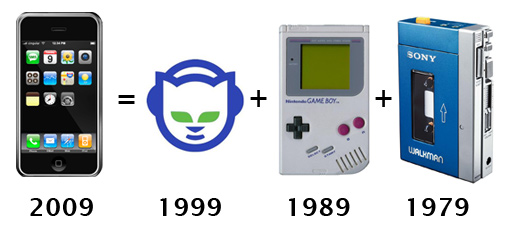
Some Big Birthdays
- On June 1, 1999, Napster was first released. I have fond college memories of Napster, but even better memories from ten years before.
- On April 21st, 1989, the first Nintendo Gameboy went on sale. I immediately asked for one for Christmas that year and in late December, I faked that I was sick, snuck into my mom’s closet, unwrapped my Gameboy, played it all day, and then carefully re-wrapped it so she would never know. I did this for at least 3 days before she sent me back to school!
- On July 1, 1979, the first Sony Walkman went on sale in Japan. Since I was just a few months old, I don’t have a fun story about it, but I have used its successors like the portable CD player, iPod, and now iPhone. To me, portable music devices, video game players, phones, and so forth are a completely normal part of life – but it was not always so!
Their Significance
Before the Walkman, there was no device specifically designed to make music an isolated, individual experience.
Certainly, a person could listen to the radio alone, but speakers were designed for everyone present to hear them. But the Walkman fundamentally shifted music out of the arena of community experience and into the realm of personal taste. Music was once a connection between the artist and the listeners. The phonograph put a device between the artist and audience, the Walkman put a device between the audience members, and Napster severed all connections completely. Never before could a room full of individuals each experience something so emotionally and viscerally powerful as music, but each be engrossed in radically different universe isolated from its creator.
The Walkman and Gameboy were but gateway drugs into our current hyperconnected, but isolated world. Today, we are surrounded by devices that take significant realities formerly known to only community – music, games, eating, and so on – and compress them into virtual spheres of expereince insulated even from those within arms reach. Now, we even watch TV on tiny screens by ourselves!
So the next time you encounter an evolutionary offspring of the Walkman or Gameboy, you might consider how it shapes and frames the way your experience the important things of this life.
Very interesting, John! I like the way you talk about “community realities” vs “virtual spheres of experience”. Once upon a time I wrote something similar, but never quite brought out the specifically community-denying aspect of the danger.
Jonathan, you had a lot of good points there, and you touched on it a bit with “iPod-induced isolations.”
I was a teenager in Japan when the Walkman came out. Suddenly, I felt like I was in a musical or a movie: I had a soundtrack to accompany anything I was doing. Even other people moved to my soundtrack (though they were unaware of it). And that may have been a significant shift towards postmodernity: I had my own private bubble to interpret the world.
…And I just noticed that that last sentence had both “private” and “world” — a Len Sweet double ring.
Jon, wow, what a cool experience. You’re right that the “soundtrack” experience seems to represent the shift towards postmodernity.
Good post, John!
Though I personally do not (and haven’t) used any of these devices, I’m always curious as to how these things “play-out” in our lives. I suppose for all their practical and recreational credits there is a reciprocal debt (as you’ve mentioned).
As a parent of three teen-aged boys, and neighbor-in-the-hood…I remain interested.
Thank you for sharing your insights, brother.
Matthew
Wow, it’s amazing you’ve made it through the last 30 years unscathed by all those devices!
I was listening to NPR yesterday and they had a piece about the glory days of the boom box and how Hip-Hop music began in a culture of people blasting their music to an (often unwilling) audience through the ‘box’. It made for a totally different cultural response to the music, which they postulated affected the type of music that was produced. Nowadays Hip-Hop music reflects a more individualized culture.
I think it’s the “Hawthorne effect”, where the subject being watched (in this case listened to) is changed ipso facto of being watched. Just another observation on how the medium changes the message, but not just for the end user, it eventually changes the speaker of the message.
Good point about the medium’s effect on the speaker.
Maybe a little off topic, but the isolation factor illustrated by the above technologies and the attempt through social internetworking to try and connect the inner self through that medium to others leads to a spectrum of responses. I saw this morning someone saying he is praying for his FB friends individually and, of course, there are Bible verses, etc. I have seen transparent sharing that makes me blush. And then there are those who react saying, “let’s keep it impersonal”–separation of church and status updates. I, too, have wrestled with how much of my Christian identity to post. Is it a tool to actively and overtly influence others towards my core values or, like in real life, should I mask my convictions and opinions to hopefully draw and attract further inquiry? WWJD? 😉
Anyway, I like your blog John. It makes me think.
Greg, the discussion of online vs. offline identity and how much they should overlap/interact is a very good one. I’d love to spend some more time thinking about it.
My main question would be “What does it mean to attempt to convert ourselves into an online representation, and how does that process affect us?” before ever getting to the question of “Is it good or bad?”
Like the prior post . . . I clearly remember walking outside in the front yard, with my headphones on, listening to a cassette tape and the sense that I had discovered the soundtrack to the film of my life. It was a bizarre experience and that I recall it so clearly 30 years later says volumes about the impact it made on me at the time.
To be honest, seeing my first home computer, the IBM PC (Personal Computer), just a few years later at a friends house did not make anywhere near the same impression. I think it was more that I had not experienced my own personal “killer app” for the PC as I had with the Walkman.
Thank you for sharing your thoughts. I really appreciate your efforts and I will be waiting for
your further post thank you once again.
Hi, of course this post is in fact fastidious and I
have learned lot of things from it on the topic
of blogging. thanks.