1984 vs. Brave New World
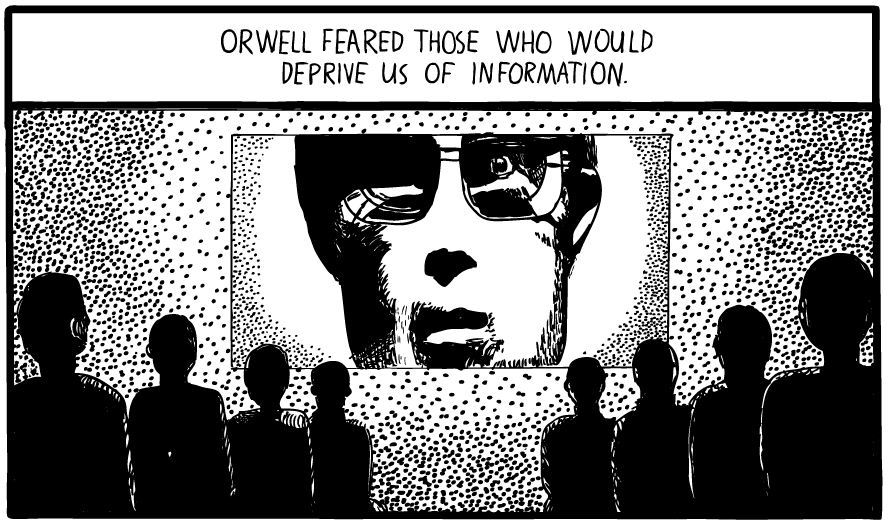
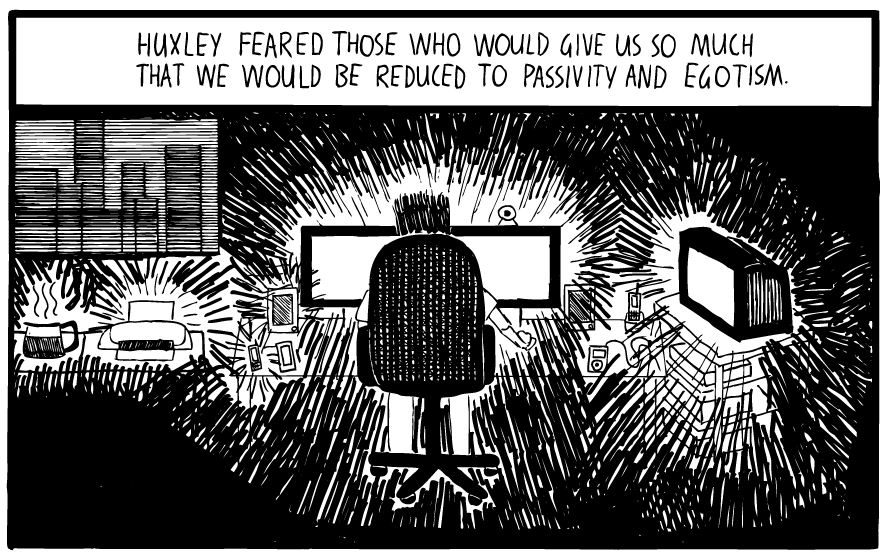
In the introduction to Amusing Ourselves to Death, Neil Postman contrasts the worries about future technology by Aldous Huxley in Brave New World (1932) and George Orwell in Nineteen Eighty-Four (1949). Though much has been made about the totalitarian government depicted in Nineteen Eighty-Four, Postman highlights how Orwell and Huxley’s contrasting worries play out in information and importance. While Orwell worried that good information would be hidden by a scary government, Huxley worried good information would be hidden in a pile of insignificance.
Postman’s words were recently amazingly illustrated by Stuart McMillen. Here is one of the panels
Dostoevsky in a 1984 world
 While we seem to live in a Brave New World, the Russian author Fyodor Dostoevsky, whom many consider to be the best novelist of all time, lived in a totalitarian 1984 like world. Because of his beliefs, his books were censored and after a mock execution he was exiled to Siberia.
But instead of destroying him, it turns out that his time in prison might have been the very thing that made transformed him from a brilliant writer to the the one of the most insightful Christian thinkers of all time.
During his exile, the only reading material that he had was a copy of the New Testament and Psalms. Though he was raised in the Orthodox church, he describes this as the time in which he came to know Jesus and experienced conversion. With no access to anything but the most significant literature ever written, he read the Scriptures over and over until it completely saturated him. And it formed his mind to create the highest of art.
Information Deprivation vs. Information Overload
Postman points out two major concerns:
- The kind of information we intake is insignificant.
- The amount of information we intake overshadows what little significant information we do intake.
In other words, if you read a passage of Scripture in the morning, then later consume lots of TV shows, blogs, and advertisements, it doesn’t matter if the content is morally good or morally bad, the sheer volume of information will dilute anything truly great and tend you toward seeking more and more insignificant material.
I have to ask myself: am I really a more intelligent, loving, godly person because of my constant access to the never ending stream of news? I imagine Dostoevsky would have longed to have the remainder of the Old Testament – do I long to be saturated by God’s word as much as I long for new interesting tech news?
How about you, are you satured with the significant or overwhelmed by the meaningless?
Ray Bradbury said his book, “Fahrenheit 451,” was not about gov’t oppression of books. (Funny, he could have fooled me into thinking that.) It was about the effect of technology on books. And on that, I agree with him. The TV of “451” pushed out books, just like it and other entertainments do today, whether or not someone burns your books. I read a short story not too long ago about a book lover holed up on a river island as angry citizens stood on the other shore, ready to burn his compound down, because he dared still read books. Then I thought, “Whom is this author kidding? The average American today doesn’t care if or what you read, and never will.” Market forces will tamp down how many saleable books come out. The true book lover will have a harder and harder time enlarging his or her library with new, good books in the future.
Brilliant man. Love this post. I love the books mentioned too. You have sent me on a tangent and quest to write more on the subject. Appreciate the work of putting this post together and your blog.
Brilliant post…Dostoevsky is what caught my eye of course…I consider him the greatest writer of all time myself.
What Postman has to say at the bottom of your post is so fascinating. I’m having to re-think a lot of stuff, and I believe that like Dostoevsky, that when we so saturate ourselves with something (be it the bible, technology, exercise, etc.) it begins to shape who we are.
The question is, what am I allowing to shape me then? I hate to say that it’s often not Christ as I drown him out in the noise of everything else…..sigh.
Rhett
I definitely live in a world where there is an unending stream of information and mediums of disseminate that information. It seems that anyone can provide information; credible or not. If there is a Big Brother out there then his circuits are going to be blown very soon, lol.
Maybe it behooves us as Christians to be ever watchful of that stream and to keep the Word on tap – close, often and consistent. That is a challenge to me – Morning Quiet times just don’t cut it when the day is spend numbing oneself up against the deafening hum of information.
btw- reminded me of one of my favorite technology quotes:
"The danger of the internet isn't necessarily the porn, but the continued wasting of time to find the next great thing." Dr. Michael Goheen
No doubt
Excellent blog you have here but I was wanting to know if you knew of any user discussion forums that cover the same topics talked about in this article? I’d really love to be a part of community where I can get advice from other experienced individuals that share the same interest. If you have any recommendations, please let me know. Kudos!
Heya i’m for the first time here. I came across this
board and I find It truly helpful & it helped me out
much. I am hoping to offer something back and aid others such as you helped
me.
My web page: zentai costumes