What Is Information?
My (awesome) brother recently took me to a Coldplay concert, and we had a blast together. But before we get to Coldplay (and Snow Patrol), let’s introduce some ideas that can help us understand the nature of information and its relationship to reality. In his book
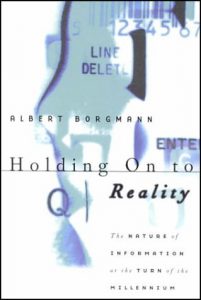 Holding on to Reality: The Nature of Information at the Turn of the Millennium, technology philosopher Albert Borgmann examines this relationship, and he indentifies three major categories of information:
- Information about reality – The first and simplest kind of information is that which describes the real world. Borgman includes in this category when Abraham builds an stone altar to memorialize where Yahweh had acted (Gen. 21:33). Abraham used physical objects to organize and inform him about the significance of a phsyical space. Other things included in this category would be things like a map or the periodic table of the elements which describe the physical world.
- Information for reality – There is also a class of information that advises on what to do with reality. For example, a recipe that records how to make the famous Thai dish Pad Kee Mow or a proverb of Solomon that tells us how to handle money would be information that helps us best live in reality. Humans have used these first two categories for as long as their has been language.
- Information as reality – Borgman argues that a third category is unique to the digital era. In the case of the Coldplay concert, information about reality would be details like the place of the concert and the list of songs played. Information for reality would be the sheet music and lyrics that describe how to replay the music. But information as reality is a digital recording of the music stored in bits of information which a device can turn back into a replication of reality.
So what does all this have to do with a Coldplay concert?
Reality Bytes #1: When Information is Better than Reality
The opener for Coldplay was Snow Patrol, and since I’m a sucker for fun, sappy pop music, I was really excited to hear them. Unforunately, it turns out that they weren’t that great in concert.
Using Borgmann’s terms, we could say that Snow Patrol songs on a CD (information as reality) are better than Snow Patrol songs in reality. We don’t have to look far to see that the modern technological world offers us many such cases where we would prefer a fabrication of reality to reality itself. In the case of a pop band, this isn’t really a big deal, but there are other cases where it is not so innocuous. For example, we can create an online identity that we prefer to our true self. We can find a pornographic image that we prefer to any real person. And we can interact with strangers online that appear preferable to those messy people that inhabit reality.
Reality Bytes #2: When Reality is Better than Information

After Snow Patrol finished their set, Coldplay came out and put on an amazing show. They are offering free downloads of their live concert, but I can tell you that being there (reality) was way better than any CD (information as reality). They are just fantastic performers.
Yet, even though the real concert was clearly superior to a recording, if you look closely at this picture I took at the concert, you’ll see that half the audience was spending their time photographing and recording the concert, updating their facebook and twitter statuses, and text messaging friends.
Of course, it’s fun to take a few moments to call a friend and let them hear the music or update your status to let people know how great the concert is. But as I looked around, I noticed that many people were doing this throughout the entire concert.
It seems that even when reality is clearly better than virtual reality, we don’t want to be fully emersed and present in that reality.
Balancing Information and Reality
Borgmann does not argue that information as reality is bad – in fact he spends a great deal of time analyzing cases in which it is beneficial. But he does argue that
We will see that the good life requires an adjustment among the three kinds of information and a balance of signs and things. (p. 6)
He is worried that we are moving out of balance, primarly consuming information as reality rather than using information to enrich reality and build meaning.
Hopefully, the next time I attend a concert, go to church, or spend time with friends, I can enjoy the reality of it all and be fully present.
John,
Dude, amazing post. I'm going to need to process your comments on people recording, photographing, etc. the concert while there in the present reality. This has really struck me recently…texting, Twittering at a Dallas Mavs game, rather than watching the game. I did the same thing at a Coldplay show last October here in Dallas. And it sort of scared me. I'm wondering how to strike this balance…..
rhett
Hey, have you seen this news article?
New details about Michael Jackson’s Death Emerge
I was wondering if you were going to blog about this…
John,
Great post bro! It reminds me of McLuhan's premise that "technology is an extension of our humanity" not the other way around (even though we sometimes become a slave to the technologies that we use).
To play devil's advocate: if we are seeing a breakdown in the barrier between the online and offline worlds, do you think that eventually our description of reality WILL include what we have commonly referred to as the "online" world. In other words, are we seeing the breakdown of "virtual" reality because so many slide in and out of both the on and offline worlds?
I just hope we don't become the humans in Wall-E. 🙂
I too hope we don't become like the fatties on Wall-E!
Borgmann also spends time talking about "contingency" which he uses to describe the unpredictability of the reality. Information can help mitigate the negatives of unpredictability (like the information that a certain plant is poisonous), but at the same time when a world is made entirely of information, it looses the beauty that comes from unpredictability. It's the improv (or "contingency") at a concert or a church service or a romantic evening that makes it reality and makes it human. Borgmann wants us to retain our contingency to retain our humanity.
So, I guess the question he might as is if the blur between online and offline can still include contingency and thus remain human.
John, excellent introduction to Borgmann's ideas for a technology philosophy noob like me. This is really an interesting way to parse information. I definitely resonate with the idea of not completely replacing reality with a digital represention of reality.