In an aticle entitled Religious Self-Profiling ChristianityToday.com reports that “Christian” is still the most frequent religious label on Facebook, many people choose not to use it. I am quoted on the second page, and I wanted to give some additional commentary on what I said there.
So, What Do You Do?
 When someone asks me what I do for a living, my answer depends on what I know about the person.
For most people I just say, “web programmer.” But if someone doesn’t seem terribly computer savvy I attempt to simplify saying, “I make websites.” On the other hand, if I know someone does computer work of some kind I get more specific and say I love to work with JavaScript on the front end, but I do a lot of backend programming in C# and some PHP, Ruby, other languages.
In other words, how I answer depends on the person asking and the context in which he or she asks.
Online vs. Offline Identity
When it comes to religious identification things get a little trickier, and many people have attempted to explain the move away from “Christian” to terms like “Christ follower.” That is an interesting discussion (recently I made hippypastornamegenerator.com to poke fun at our pomo resistance to traditional terms like “Christian” and “pastor”), but what I’m interested in here is how online profiles as a technology has influenced and shaped that larger issue of identity.
Let’s contrast how the technology of a website profile differs from a face-to-face interaction.
| Offline | Online |
|---|---|
| Contextual | Decontextual |
| In the story above, the way I describe my job is tied to a specific setting, time, and individual. The words I use are tied to a a specific context. | In contrast, a website profile is completely decontextualized – that is, it is removed from any specific situation, time, or person. It is purely abstract, and it only gives one answer regardless of the setting, time, or person. |
| Oral | Text-Based |
| When face-to-face, we use the spoken word in a dialog. Speech has a give and take, and we adapt what we say to the other person’s understanding and based how they react. The spoken word also has a difference sense of permanence than written words. | Online we currently are limited to text-based descriptions of ourselves. This may not seem significant, but linguistic studies show that the mind interprets an individual word sitting on a line differently than a word situated within in a sentence and a sentence within a conversation. |
| Asked | Declared |
| In person, subjects like jobs, religion, and politics usually don’t come up until one person asks another about it. We usually don’t immediately declare such affiliations unless there is some kind of special circumstance | In the online world, our profiles don’t wait until someone asks us about these thing. Instead, the technology of the profile declares without being asked. |
This means that online and offline identification are quite different. The technology of the profile introduces an alternate way of sharing one’s identity with another person. The identity presented is shaped by and confined to what the technology can and cannot do. Our identities are also shaped by what the profile chooses to emphasize. For example, Facebook puts religion and politics next one another reinforcing that they are related either in meaning, significance, or both.
Working Within and Against Technology
In the fall 0f 2008, I changed my view to say
Political View: Someone will be president
Religious View: Someone else will be King
It seems a little childish to me now, but at the time I was attempting to work within the system’s constraints (politics and religion are linked) and contextualize my answers to address the current political climate in which both major parties emphasized that their “hope” lay in who was president. I wanted to reframe the discussion in a way that put my hope in Christ as King over which candidate would eventually run the United States.
In other situations, I’m happy to use the term “Christian” or “evangelical” (no need for hippypastornamegenerator.com names) or even to discuss the candidate for whom I voted, but it’s not something that I think the technology of profiles is particularly well suited for.
So how do you identify online? Do you use traditional terms offline? What limitations do online profiles have? What advantages do you see?
Update: As my dear friend Matt Anderson points out, online and offline identification cannot always be cleanly separated as I argue here. The offline world has quite a bit of involuntary disclosure as well.
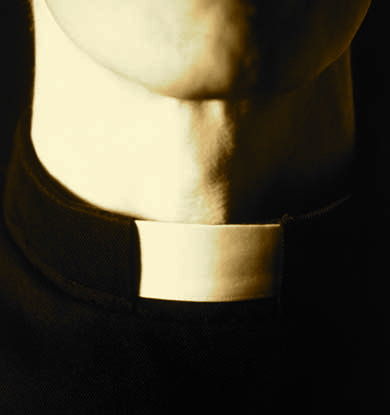
I agree with him, and the photo on this post along with my comment about priest’s collars in Christianity Today was meant to suggest that. The things we wear (priest collars, Rosaries, job uniforms, athletic clothing, grubby garments vs. high fashion attire, etc.) and our bodily distinctives (gender, tallness or shortness, missing limbs, colored hair, the color of our skin, etc.) often “declare” in a non “oral” and “decontextualized” way much about our identity.
However, in regards to the specific case of online religious and political identity, facebook does reframe these parts of ourselves in a way that is distinct from what we do offline. A priest can choose when and where (i.e. in what context) to wear his collar just as an Applebee’s employee can take off her vest of flare before going to a funeral. In contrast, a website profile can only “be” or “have” one religious identification. It cannot choose based on context because there is only one context – the website itself.
I changed mine about the same time you did I think. They were vague before, but I stepped away from saying anything and towards encouraging others to engage me. As you mentioned, this is the sort of information that needs both context and I don’t want to come across hard-nosed in declaring something. I want others to know I respect them before they dismiss me for my perspective on life.
So here’s my answers on Facebook:
Political Views: I prefer to talk issues, not affiliations. They don’t really get me anything.
Religious Views: Definitions seem to cloud the truth. I’ll gladly share if you really care.
Thanks Josiah!
Political Views: Well, I do have them occasionally
Religious Views: Isn’t it less about how I view religion and more about how I live in spite of religion?
Mine is pretty much the same across the board. The only significant difference might be the level to which I elaborate given the space or the time constraints.
I don’t recall often being asked what my “views” on politics or religion might be. The question is usually framed in a more conversational manner when “offline”.
Bill, yes I agree that usually these issues come up conversationally, not in the overt and direct way that profiles ask them.
You’re spot on the difference between online and offline self-definition.
And I like your juxtaposition of politics and religion. When I was on Facebook I listed my religious views as “Christian,” but my political views as “Atheist,” thinking of Ellul’s comment in The New Demons:
“Everything is political. Politics is the only serious activity. The fate of humanity depends upon politics, and classical philosophical or religious truth takes on meaning only as it is incarnated in political action. Christians are typical in this connection. They rush to the defense of political religion, and assert that Christianity is meaningful only in terms of political commitment. In truth, it is their religious mentality which plays this trick on them. As Christianity collapses as a religion, they look about them in bewilderment, unconsciously of course, hoping to discover where the religious is to be incarnated in their time. Since they are religious, they are drawn automatically into the political sphere like iron fillings to a magnet. …
Everything which carries the political message, everything expressed in terms of political commitment, is now justified and legitimized.
That is the new soteriology.”
Wow. I love the contrast of “Christian” for religion and “Atheist” for politics. And I’m a sucker for good Ellul quotes.
So how do we tag ourselves on the internet?
Because the extreme political polarity in the US in general and in US Christianity in particular, I’ve removed any political statement in Facebook. I may just adopt Josiah’s.
For my religious views I’ve been using “Post-conservative evangelical Christian” which communicates more to insiders than outsiders. I’m not sure what to change it to.
When Facebook was only church, friends, and my students from the university there was no problem. But now my professional colleges are starting to find me on Facebook. It is not clear how to tag my self so that others get an accurate idea of where I am. Sadly there is much in Christendom that I do not want to be associated with; much that makes me ashamed of the label “Christian.”