 The Best 2 Hours of the Day
During a normal work week, I get home around 5:30 and I put my son down for bed around 7:30. That means I have a maximum of 2 hours per day to foster one of the most important relationships I have. It also means that I have a whopping 22 hours a day to check email, facebook, twitter, read, sleep, etc.
Even though I have “all day” to check email and just two hours with my family, it’s hard for me to turn work off when I get home. I often find myself reaching for the phone in my pocket, believing that the world out there is somehow more important than the world right in front of me.
So for that window, I’ve decided to just pack up my devices where I can’t get to them. When I pull in the driveway, I leave my computer in my car or in the laundry room that sits between our garage and family room. I also like to leave my phone in there as well, although I keep it if I know I’ll be taking my son on a walk or doing something where I might truly need it.
Creating Space for Community
At a recent tech conference, I heard of a family that does something like this but with all of their kids [HT: Lars Rood]. The parents used to tell the kids “no computer during family time from 6-8pm.” But the kids would do it anyway.
Their excuse? Dad does work some times in the evening and mom talks on the phone to her friends, so why can’t we?
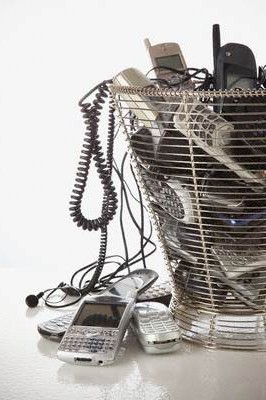
In response, the parents created a special family basket and asked everyone put their most tempting electronic devices in for a few hours each evening. Dad put his work laptop in, mom put in her Kindle, and the kids dropped off their cell phones. Instead of just mandating rules, the parents decided to model how they wanted their family to operate. And instead of focusing on how to limit technology, they focused on opening up a space for conversation, games, and meals.
At any time, the parents and kids can look over at the basket and see what’s there and what’s not and hold family members accountable to it. As a bonus, the basket serves as a powerful physical reminder that the entire Internet and all its wonder can be relegated to a few inanimate devices in a trash can.
Being Practical
As always, every family is different and this might not work for everyone. You might be a doctor or someone really important like Ashton Kutcher who needs to be on all the time. Homework, grading, emergencies and so on will also occasioanlly break the rules. But I still think the idea is a wonderful practice even if it’s just a few nights per week, and I hope that as my children grow older my wife and I can implement something similar and model togetherness, physical presence, and the fullness of community.
Do have any tips for using (or not using) technology in community?
Speaking as a (single, no kids) guy, I do something similar and its made all kinds of nice with others around me. When I get in from the office, I usually set my mobile in a separate room, and then spend the next hour or two watching a movie, connecting with others, reading a book, or biking. After that hour or so, I’m free to reengage my tech – and in my case, I’m less willing to go overboard for the rest of the night since I’ve literally just come off of it.
I’ve found it challenging and at the same time worthwhile to take that time and either keep it in silence or fill it with the space of maturing some relationships around me. And in doing this, I’ve been much better able to see where certain types of tech behaviors that are supposed to be “corporate culture” are more like fostering a lack of personal and professional boundaries.
Antoine,
Thanks for sharing that perspective. It seems like that for you having a regularly scheduled media-free time means you’re able to avoid the need for a long sabbatical. Good stuff!
I’ve found this really cool button on my Blackberry. It turns out that pressing the “end call” button for 2 seconds tells everyone that you are busy with your family. What’s more, all of the messages that people leave while you are with your family are still there when you turn the Blackberry back on – you don’t miss anything after all – its AMAZING what they can do these days!!
Haha! Good point – sometimes the simple solution is the best!
I think it’s wonderful that you’re able to have so much self-control with your media. However, I’ve found that once people go down the path of being over connected, the “just turn it off silly” advice doesn’t seem to help them much. And it’s all but useless for parents trying to talk to their kids. Also it doesn’t do much for anyone wanting to practice technological awareness within a community rather than just as an individual.
Two hours a day is really just a minimum, too. You need time for your kids, time for your spouse, time with your God. As a technologist, I have always been a big fan of, well, technology. However, that is changing. As I get older (turning 50 this year), I am finding that all the years of multitasking and being constantly available and drinking from the firehose of the internet has been done at the expense of my ability to concentrate. It’s gone. I’m essentially suffering from adult onset ADHD. It affects my prayer, my reading, my meditation. My mind is bouncing around like a superball. The times when I get my total focus on something are very precious to me now. We don’t really know what long term effects all our information and communication devices have upon our lives. However, I’m not convinced it’s all good. Put the Berry/iPhone/iPad down and live for a while each day. Redeem your time wisely.
Thanks Jerry. It’s good to hear from someone with longstanding experience with these things.
I work from home a lot, and I turn my laptop off when work is done (between 1700 and 1800). I only turn it back on if I need to do something important – like book a flight for the next week, or update the wedding site, or get a credit card statement for my fiancee.
Otherwise, it’s off in the evenings. And I won’t turn it on during the weekends except for similar scenarios.
But my desktop computer can’t fit into a basket. Oh well I guess we can’t do this. Thanks for the tip anyway, John. /sarcasm
put your mouse or keyboard in the basket 🙂 I was thinking the same thing!