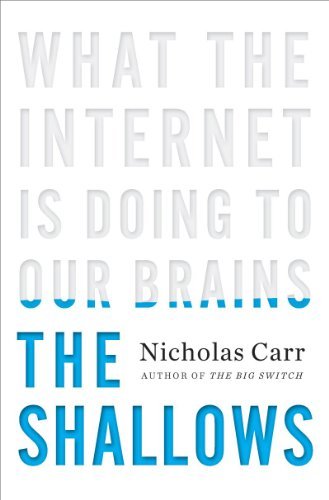
 Nicholas Carr’s new book The Shallows: What the Internet is Doing to Our Brain has not officially been released, but snippets of Carr’s ideas are showing up around the web, and they are worth talking about.
If you’re not familiar with Carr, he created quite a stir back in 2007 when he asked the question “Is Google Making Us Stupid?” in an article in the Atlantic. Since then he’s spent a good deal of time collecting research into how using the Internet – from twitter to blogs to wikipedia to video – changes the way our brain works.
Mental Adaptation
The major premise of Carr’s work is that brain adapts to repetitive actions just like a muscle. If you go jogging frequently, your leg muscles lengthen and elongate. If you lift heavy weight over and over, your muscles get bigger and more dense.
Theoretically, when you do certain mental tasks (reading, memorizing, etc.) your mind also adapts. If you read a lot of books, your ability to grasp large concepts tends to improve as does your vocabulary. If you read a lot of tweets, your ability to consume lots and lots of small sentences increases.
But each new task brings with it a set of trade offs. Just as marathon runners can’t bench 300 pounds, and dead lifters can’t run marathons, literature professors don’t tend to enjoy reading 1000s of tweets, and twitter junkies don’t have usually have Dostoevsky next to their iPhone.
How to Our Brains Adapt to Internet Links?
As he considers the trade-offs of various reading technology, Carr contends that reading text with a lot of links embedded changes how we process information and the results are mostly bad:
Links are wonderful conveniences, as we all know (from clicking on them compulsively day in and day out). But they’re also distractions. Sometimes, they’re big distractions – we click on a link, then another, then another, and pretty soon we’ve forgotten what we’d started out to do or to read. Other times, they’re tiny distractions, little textual gnats buzzing around your head. Even if you don’t click on a link, your eyes notice it, and your frontal cortex has to fire up a bunch of neurons to decide whether to click or not. You may not notice the little extra cognitive load placed on your brain, but it’s there and it matters. People who read hypertext comprehend and learn less, studies show, than those who read the same material in printed form. The more links in a piece of writing, the bigger the hit on comprehension.
Wow, not too positive, eh?
However, I would think that the same thing could be said of footnotes28 and endnotes29 in print. Although academics seem to do just fine wading through seas of superscripted numbers, when I read dense academic works with lots of footnotes, I constantly wonder, “Should I check the note or continue?”
What about Bible Verses?
Do the chapter and verse numbers in the Bible add a similar “cognitive load” to our reading of the Scriptures?
I haven’t seen any cognitive studies on Bible reading with and without verse numbers, but history suggests that they have made a difference. Today, the Bible is almost unrecognizable without chapters and verse numbers, but it wasn’t until the 1550s that Robert Estienne standardized verse numbers for his Greek lexicon. That means that from Moses (1500 B.C.) to Luther (A.D. 1500), believers had no concept of memorizing a “verse” or debates about the “red letters.”
As helpful as they are, these are technological tools that we’ve added to the Bible, and now these tools shape the way we approach the words of God. This is even more pronounced with study Bibles where the Biblical text is less than 50% of the words of every page.
Delinking
Following Nicholas Carr’s suggestion, here are the links that would normally have been embedded in the text above:
- The Shallows: What the Internet Is Doing to Our Brains
- Carr’s article “Is Google Making us Stupid?”
- Carr’s post “Experiments in Delinkification”
- Chapters & Verses: Who Needs Them? by Christopher R. Smith
- The Books of Bible – printed Bible without notes or numbers
Notice how different this post is without those links embedded throughout the text.
Deversification
If you try reading a Bible without chapters and verses, you might find that the change is even more drastic. It’s quite different to read Acts without the chapter divisions dictating the narrative pace or to study Romans without the verse numbers splitting up Paul’s arguments.
Does that mean chapter/verse numbers are bad? Are study Bibles and red letter editions evil plots by the Devil? No, of course not. In fact, they are incredibly helpful study and reference aids.
But we still need to be aware that every time we open a printed Bible and every time we fire up the Scriptures on our computer and phones (or use one of my fancy tools http://biblewebapp.com), there is a lot of extra “stuff” that can be quite distracting and which might influence the way we encounter the God’s word.
So if you’re interested in trying a Bible free from the technology of numbers, links, colors, and cross references, check out the “Books of the Bible” project where you can download entire sample books and buy printed copies.
Try reading Genesis or Philippians and let me know what you think…
I am starting to put a blog Bible commentary on James and realized that if I read within the context of the chapter and verse numbers, I wouldn’t be able to truly represent what the writer was attempting to get across. I really think if you are going to read the Bible, you need to read it as a novel. Follow the sentence, make sure you have read the full, complete thought (which might go for a few verses depending on the writing style) and then make sure that the context is correct.
In a way, I wonder if such things like “clobber verses” would even be an argument if chapter and verse were not part of the Bible. I think that the way the verses are combined create a detrimental squishing of three types of law into one.
Very good thoughts John.
Ben, great points on reading, context, and “clobber verses” (those are like “proof texts” right?)
Thanks for the link to bibles without chapter and verse. I’ve often wondered what that would be like and wanted to read it that way. I’ll have to check it out.
If you come across any other versions, do let me know.
If you’re using Accordance, you can set the preferences to “omit entire reference” and hide such things as superscripts, red letters, etc., then you can pick a book read it the way you’ve described.
I’ve never done this before because I never thought of it. Thanks for the idea and for such an insightful blog, btw.
While chapter and verse numbers provide a handy reference system, one downside is that they’re completely opaque. If you know your Bible well, you may know what Eph 2.8 is: but if you’re outside the culture, you’re out of luck (and the reference system itself serves to _reinforce_ that cultural difference). Compare that with (good) URLs: you don’t know what content is at http://donteatthefruit.com/2010/06/are-chapter-and-verse-numbers-making-us-stupid either, but at least you’ve got some clues.
One of my motivations in creating the Composite Gospel (http://semanticbible.com/cgi/cgi-overview.html) was to experiment with a more “contentful” way to think about reference, based on standardizing titles of pericopes, and closer to what we do (informally) when we say “you know that story Jesus told about the Lost Son? …” Of course, chapter and number are pretty well-established (and useful!) notions, and i wouldn’t argue to get rid of them.
Long long ago, when i was doing manuscript studies with IVCF, we got rid of the numbers (and the paragraph and chapter divisions, and pretty much everything else that wasn’t the words of the text itself) as a way of focusing attention on the text. I found it a very helpful approach.
Sean, always great to hear what cool stuff you’re cooking up. I hadn’t seen your Composite Gospel project before – great stuff!
I find it very interesting how many scriptures are mishandled theologically because of the contextual issues provided with chapter and verse.
Aaron, do you have any good examples of this you can share?
1 Peter 3:1 starts with “Likewise, wives” or “after the manner of” pointing to 1 Peter 2 example of Christ suffering but rarely is it preached as a whole. Thus, losing the merit of the “likewise” of the wives and husbands.
Death & Life in the Tongue?(Pro 18:21) I wrote about this verse on my blog. Without the break of verses we might not look at Proverbs like a book of fortune cookies.
http://aaroncirilo.org/2010/05/30/death-life-in-the-tongue-huhpro-1821/
These might not be the best examples but I’m preparing for teaching tonight.
God Bless
Thanks Aaron. Those are super helpful examples.
How about Ephesians 5:22 (“Wives, submit to your husbands…”). It seems that men like to forget all the stuff before, and more importantly after this 1 verse. 8^D
In all seriousness. This does raise a very good point. My Ryrie Study bible is chalked full of start, letters, roman numerals, and other stuff to provide the context, which is good for the intense stuff. But I also have a small NASB bible that is just verses, which doesn’t distract much. Most publishers these days are good with indicating new paragraphs, so that you can see the proper breaks in thought, even if in two column format.
yes ha I carry around small ESV.. unlike KJV it is paragraph formate which also helps. My Logos bible program on PC allows for several different layouts on breaks, paragraphs, etc. it helps.
Can you direct me to a link that I can purchase a nasb bible that does not contain paragraph and verse headings? I have searched and searched and have come up with only the nisb and I don’t like it at all.
A friend and I were just talking about this issue today!
The idea of footnotes even came up. The difference, I think, between footnotes and hypertext is that the possibility of distracting from the main/original topic is very difficult with footnotes. Would you agree?
I definitely agree with the idea that the introduction of chapter/verse (originally to improve specialized study) has hampered our holistic approach to books of the Bible.
Love your blog.
Steve, great comments. Yes, I think while footnotes can create a temporary distraction to look down at what’s at the bottom of a page, you can’t go any further after that. With links, you can click endlessly and go way off track from the original point.
Great minds think alike! I was planning to write about this sometime this month (and still will), but I just alluded to it last week at http://openscripture.blogspot.com/2010/05/oet-literal-version.html
Sounds like a great project!
The whole question of dividing up the biblical text is fraught with implications in the Ephesians 5:22 example that Sean mentions above the issue is not so much verse, and even less chapter divisions but the way in which many Bible publishers bang a section heading (or at least a new paragraph between this verse and the one before. Potentially totally changing the meaning!
Like hyperlinks, chapters and verses are really really useful 🙂 But perhaps like chapters and verses (from 16thC) and section headings (from 20thC) are dangerous as well as helpful 🙁
In both cases (hypertextsand Bibles) caveat lector!
Excellent example (like the 1 Peter one above).
We use periods and paragraph breaks and chapters in books to provide breaks. We also paginate which breaks the flow of the text [or reading on a computer, see one screen at a time]. In a newspaper, we use headlines and subheadings.
Are we saying we want to go back to scrolls??
P.S. I much prefer having the links at the end of the article, after I’ve finished reading the whole thing!
Annie, yes all of our tools for language and the Scriptures (periods, paragraphs, verse numbers, study notes, etc.) have pros and cons. Our concern is to be aware of those pros and cons so that we don’t let the tools dictate how we approach the scriptures.
Hey John, great article… thanks for sharing. I get distracted very easily, and what you described with people reading online and then clicking on link to link is me much of the time.
One of the WordPress plugins that I love is RefTagger – http://www.logos.com/reftagger. I can read through someone’s blog entry that references verses, and if I don’t know what the verse says right off the bat, I can get a great idea of what it says by simply hovering over the Bible verse, and it shows part of the verse. For long verses referenced, it doesn’t provide me with the whole text, but it’s enough for me to understand how the verse plays into what he/she is talking about. And it’s usually enough to where I don’t feel the need to click to read the rest of the Bible verse, so that I can continue reading the entry. I know you already know about this plugin…
But anyways, thanks again for the insightful article…
I love RefTagger – good stuff.
It might be interesting to integrate both with and without options into an online/electronic Bible – both have some benefit, and having both in a single place would make sense.
I find the red letter thing a worrying trend – at times people tend to infer that the words of Jesus spoken in the gospel are somehow more important than the words of Jesus (as God) spoken through the writers of the other scriptures. This seems to me to be a leaning away from the doctrine of inerrancy.
Just wanted to bring Tom Krazit’s article and video interview with the author to your attention: http://news.cnet.com/8301-30684_3-20009036-265.html
Thanks for the article! I have long been frustrated with footnotes in particular, even more so than Internet links — it’s even less of a choice — one’s eye is nearly irresistibly drawn down to the bottom of the page when coming across a footnote. I got a nearly footnoteless Bible a few years ago precisely because of that.
The “Books of the Bible” project sounds interesting, but I wish this was available for ESV, or other versions. I’ve been trying to stick with one version (ESV) for reading, other than when I’m studying a particular passage and trying to get a handle on the different possible readings. (Maybe you could do a piece on the pros/cons of the plethora of versions of the English Bible — unless you already have, and I missed it.)
KJV without verse or chapter numbers (originally published in 1936) available for free .pdf download here: http://www.archive.org/details/bibledesignedtob012390mbp
Thanks David!
I tried this one, but some of the books in the Bible are missing (i.e. Amos) and not all of the Psalms are listed (It goes Psalm 1, Ps. 2, Ps. 4, Ps. 6….; it skips). I assume other things are messed up, too, but I didn’t check, just letting you know what I saw…
But besides that, I liked reading without the verses or numbers listed so much I got a copy of Books of the Bible. It feels like a simpler read and less distracting 🙂
*oh I found Amos! Nevermind that!
The worst aspect of the divisions into chapters is that they tend to hide the internal divisions into literary units. See my site, chaver.com, for many examples, including a full text of the Torah divided according to literary units.
If chapter and verse numbers are what has caused recent Christians to only ever head snippets of the Bible out of context, than that would perhaps explain the cherry picking of quotes, and selective retelling of stories, and has probably been a good thing, and why Christianity has become more benign over time, and why secular culture now puts pressure on religious culture to ‘get with the times’.
I’m reading the Bible cover to cover, book by book, without being told how to read it, or being pointed to any particular chapter & verse index, and it’s horrific so far.
It is 100% apparent that the Christians I know have never done this. Even the classic Bible stories I was taught in school are not at all as they were presented back then. They were heavily censored and portrayed the characters as being much nicer than they were.
It is clear that the characters, at least in the Jewish texts where I am up to currently, are not contemporary men, and would be considered absolutely lunatics if they were alive now. I know which era I’d be happier to exist in.
I’m well aware the New Testament is supposed to be far less hideous, but no amount of good to come could redeem the violence, sexist, slavery and honestly mostly boring and childish content I’ve read so far. The last few books have read like some kind of ISIS conquest.
I think the only reason Christianity still exists today, at least while firmly attached to and grounded on the Jewish texts, is exactly because of chapter and verse indexing.
I was raised Christian in an American sect quite famous for actually referencing the Bible a lot, and attempting to base ‘policy’ on it.
Its own publications used book-chapter-verse references like citations in a technical book.
But even we were never encouraged to just read the books of the Bible for ourselves, without guidance or a prepackaged interpretation.
While chapter and verse numbering allows, in my experience, most contemporary Christians to be ignorant of the true extent and context of the Bible, I’m certain that removing such numbering, and getting average and decent 21st century people to read it for themselves would have the opposite effect on them.
It would take a lot of mental gymnastics to reconcile the idea of the heroes of the Bible being good men, or that what is good and moral can change depending on time or location.
Chapter and verse numbering is I think vital to modern and more benign Christianity, particularly outside of the US. Being vague and cherry picking by index is about the best you can do for a text that really shows its age.
I cannot believe I was given this book as a child, except for the fact that it’s a given that people stop reading when they get to the boring geneaologies, and would sooner read a pamphlet, or listen to a sermon that they think summarises the stories accurately.
They do not.