Archive for the ‘Books and Texts’ Category

My Son, the Social Genius My 8 months old son Benjamin is becoming quite a hilarious little character. Lately, when friends are visiting and we get into a good discussion, Benjamin has started to notice that he’s not the center of attention. Since he doesn’t really know how to just hang out and he doesn’t [...]

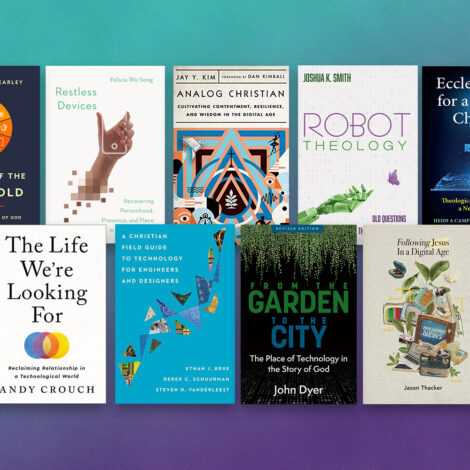
What Is Information? My (awesome) brother recently took me to a Coldplay concert, and we had a blast together. But before we get to Coldplay (and Snow Patrol), let’s introduce some ideas that can help us understand the nature of information and its relationship to reality. In his book Holding on to Reality: The Nature of [...]

1984 vs. Brave New World In the introduction to Amusing Ourselves to Death, Neil Postman contrasts the worries about future technology by Aldous Huxley in Brave New World (1932) and George Orwell in Nineteen Eighty-Four (1949). Though much has been made about the totalitarian government depicted in Nineteen Eighty-Four, Postman highlights how Orwell and Huxley’s contrasting worries play [...]

A psychology professor at Stanford University found that in languages with gender, the gender assigned to an objects tends to shape the way a speaker views that’s object. For example, in Spanish, “bridge” is masculine so Spanish speakers describe bridges as “strong” and “dangerous,” while German speakers for whom bridge is feminine tend to describe [...]

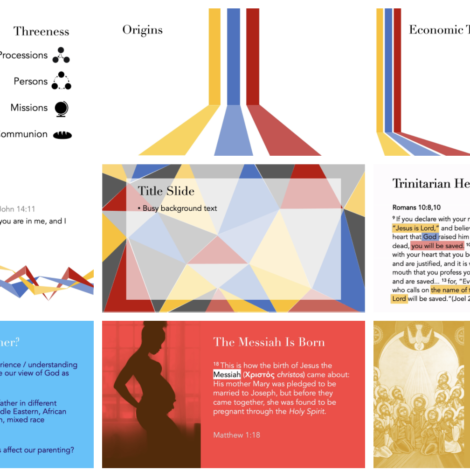
The fine folks at Logos have posted the audio and slides of the BibleTech:2009 conference talks. Here is my presentation slides synced with the audio using slideshare.net. (note: the title is a nod to Shane Hipps’ book Flickering Pixels: How Technology Shapes Your Faith) Technology is Not Neutral: How Bible Technology Shapes Our Faith

The Question T. David Gordon believes that the majority of preaching today is rather poor, not so much in its content, but in its form as preaching. As a practitioner of preaching for decades and now as a professor of media ecology, Dr. Gordon is uniquely qualified to ask this question: How has the movement [...]


About this blog

John DyerI'm John Dyer a web developer working on sites like Best Commentaries, Bible Web App, Dallas Seminary. I'm also a seminary graduate and teacher at Irving Bible Church.

This blog is about the the role of technology in the redemptive movement from the Garden to the City. I believe technology is an amazing testament to the creativity embedded in the imago dei, but instead of assuming technology is always a neutral tool, I believe it - like culture in general - profoundly influences us.

Upcoming Posts

  • 3D TV Means Color TV is New Black (and White)
  • What Are They Advertising?
  • Jesus, James, and McLuhan On the Heart, the Tongue, and the Internet
  • A Definition of Technology
  • The Cornwall Alliance: Technological Theory at Work
  • Reading and Publishing and Publishing and Reading
  • Learning from Buber: I-Thou and I-It
  • Prepackaged Communion and Albert Borgmann’s Device Paradigm
  • Technology is Kinda Like Money
  • Tristan Mason: John, I'm looking forward to that post. It seems to me that Jesus' coming was, in one way, the tran [...]
  • John Dyer: Paul, Yes, in a later post we'll talk about the debates in the early church about the meaning of im [...]
  • John Dyer: Lee, for sure! Moving from Oral to writing communicates a sense of authority and permanence. [...]
  • John Dyer: I can't remember about that one. If you find something and can draw some meaning from it, I'd love t [...]
  • John Dyer: God also spends much of the Pentateuch giving blueprints for various elements of worship. The point, [...]

Asides

Our brains are designed to more easily be stimulated than satisfied
Fascinating look at the science of the brain’s response to seeking and rewards: http://www.slate.com/id/2224932/ (1)

Roman Catholic Church Expresses Concern Regarding Social Technologies
The head of the British Roman Catholic church says,

“I think there’s a worry that an excessive use, or an almost exclusive use of text and emails means that as a society we’re losing some of the ability to build interpersonal communication that’s necessary for living together and building a community.”
(0)

Internet Fatigue
CNN has a report on the phenomenon of internet fatigue. I wish they would have spent more time on giving suggestions for how to understand why this happens and how to avoid it. (0)

Articles and Tools on Texting
The NYTimes has a new article on the effects of texting on youth which include anxiety, sleep deprivation, and hand injuries. Interestingly, as Andy Crouch points out, the article also mentions that teens send many texts to their parents, meaning that teens are now connected to their parents more often during the day – a time when teenagers of the past were developing independence. LG has also created a new site to help parents decode text messages. (0)

Course Syllabus: Writing for Nonreaders in the Postprint Era
A humorous, but enlightening syllabus for a class on writing in the “postprint” era. Writing for nonreaders in the postprint era: “Students will examine why former generations carried around heavy clumps of bound paper and why they chose to read instead of watching TV or playing Guitar Hero.” (0)

Language Shapes Our Worldview
A psychology professor at Stanford University found that in languages with gender, the gender assigned to an objects tends to shape the way a speaker views that’s object. For example, in Spanish, “bridge” is masculine so Spanish speakers describe bridges as “strong” and “dangerous,” while German speakers for whom bridge is feminine tend to describe bridges as “fragile” and “beautiful.” Perhaps our own understanding of words like redemption, wrath, and adoption are also shaped by unseen factors. (0)

Survey Says Facebook Users Get Lower Grades
A study from educational researches at the Ohio State University found that students who regularly used facebook only study 1-5 hours per week and had GPAs in the 3.0-3.5 range, while non-facebook users study around 11-15 hours per week with GPAs in the 3.5-4.0 range. I wonder how church education compares? (0)

Risk-Reducing Technologies Increase Risk-Taking
The Pope and a Harvard scientist make an interesting argument that AIDS is increasing in Africa precisely because of condom distribution. More... (0)