Crash, Bang!
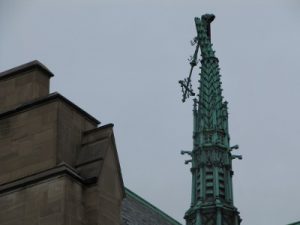 In case you missed it, there were some storms last week. First there was a tornado.
Then John Piper offered an interpretation of the tornado and a bigger storm hit. In a mere 24 hours, there were hundreds of comments, thousands of tweets, and dozens of counter-posts by pastors (Boyd, Jones), professors (McKight), and others (Spencer, Kinnon, Coker).
I have no desire to further the debate over whether Dr. Piper’s assessment was correct. Personally, I think John Piper has served the Lord well in his time on earth, and any critique I would offer of his ministry would amount to little more than a baby whale spouting next to an aircraft carrier. What I am interested in is what we can learn from the story of Piper and his critics about Internet theological discourse regarding contentious issues.
Godwin’s Law for Christian Discourse
When it comes to Internet theological debate on hot topics, there seems to be a sort of Christian Godwin’s Law at work. If you’re not familiar with it, Godwin’s Law was humorously submitted by Mike Godwin almost 20 years ago in the early days of the Internet. It states:
As a Usenet discussion grows longer, the probability of a comparison involving Nazis or Hitler approaches 1.
In other words, debates will inevitably end with one person comparing the other person’s views to Hitler. It turns out that if you replace “Hitler” with “heresy,” you’d describe about 86% of debates on Christian blogs and forums on hot topics. In the case of Piper, he made a similar argument about calamities previously, but no one seemed to notice since it didn’t touch a contentious issue. However, when he made a case that addressed the issue of homosexuality, the “h” word came out within hours.
Now we could dismiss this by saying that people argue on any medium. And that’s true – remember Cain and Abel? But I think that the Internet itself, for all its strengths and all the promise it offers, is uniquely suited toward pushing these controversial debates further and further, and below I offer three such reasons why this is almost always the inevitable result.
The Internet Discourages Time for Reflection
The speed of discussion on Internet means that anyone of us can immediately give our opinion on world events and lofty theological ideas to a huge number of people we know nothing about. With no limitations on authorship, no editorial oversight, and no time to publication, we frantically peck out words seconds after an event. The virtue of “first post” seems to ride high above and virtues of patience and forbearance.
Compare this to the time before the Internet, when news would reach us more slowly. Without dozens of outlets for our every thought, our reactions would have to percolate in our minds for a while before they could be released into the world. It doesn’t mean they would be automatically better, but at least we would be prevented from making snap judgment about a post we just scanned.
The Internet Strips Away a Relational Context
On one hand, it’s not too hard to see why Piper’s conclusions would seem offensive or unbiblical to some readers. Yet when he took time to further explain the context of his comments and how they fit into his life experiences, they seem to make more sense, even if we might ultimately disagree with his conclusion.
Almost any discussion is enriched when it takes place in the context of an existing relationship, because the person on other side of the table can filter our words through our shared and individual life experiences, something the person on the other side of the screen cannot do. Rather than frantically typing at anonymous avatars, relational context allows us to converse and exchange as brothers and sisters.
Of course, when Piper writes a book, his audience is still people he doesn’t know, but the medium of print has three important differences the medium of blogging. First, the time between the event and the publication would be much longer meaning that Piper (and his editors) would have more time to craft the words and consider their impact. Second, his thoughts would be couched in a larger, more nuanced book level discussion which might allow us to disagree more gently and thoughtfully. And third, a reader would not have an immediate opportunity to respond, meaning that he or she would be forced to think before communicating.
The Internet Promotes Disregard for Authority and Community
The Internet is not merely a means of communication, it is more fundamentally about giving individuals the power to choose what information they consume. The trade-off is that the more choices we have, the more decisions we make in isolation and the fewer we make either in community with others or under the authority of leaders.
Of course, I could claim that the Bible is my authority and that my view is more biblical than that of Piper, Boyd, or the iMonk. But everyone claims the Bible is their authority. Bible, Bible, Bible – everyone quotes the Bible. What’s really happening is that I “agree” with leaders when their interpretation of the Bible matches up with my personal views. The Internet simply gives me more views from which to choose.
And the more choices I put in front of myself, the more choices I make. The more choices I make, the more I believe in my ability to chose. In the end, my authority is not the church, nor the Bible, it is my will to choose.
There’s a Time for Everything
This is not to say that no good theological discussion happens on the Internet or that nothing from Tornado-gate was worthwhile or helpful. Instead, I am simply saying that certain theological topics will almost always follow Godwin’s Law when they are discussed on the Internet. Without time, relationships, and context, it’s extremely hard to make sense of these complex issues and online discussion will rarely avoid devolving into accusations of heresy.
So next time a big event comes up, or next time someone make a post on a contentious issue, slow down, grab a friend, stock up on a favorite beverage, and hash it out offline.
Then go comment wild.
John, this is brilliant. Thank you. Regarding Godwin’s Law, I’ve heard it said that whoever plays the “Hitler” card first has, at that moment, lost the debate. I think your observations regarding the rush to extremes (devoid of the natural consequences of such extremes within relationships) in an internet debate are right on target.
Thanks so much for this excellent resource, brother. God bless.
Thanks Josh!
Unless, of course the argument is about Hitler 🙂
Yes, please see: http://xkcd.com/261/ =)
A fine post, Josh — is all your stuff this good?
Glad you like it Ray, and thanks for your kind words. Check around the rest of the site and see what you think.
The baby whale comment is classic. Well spun.
For the record, the conversation between myself, Kinnon, and Dash began before Piper made those comments…although the interwebs storm didn’t rage until after.
“The more choices I make, the more I believe in my ability to chose. In the end, my authority is not the church, nor the Bible, it is my will to choose.”
Actually, your authority IS your will to choose (at least, for now). Kingdoms are ruled by consent. That’s pretty close to the heart of the debate.
Happy to know you liked the baby whale comment 🙂
I actually meant to link to your more recent post, and I’ve gone back in and fixed it, but I’m happy to remove it if you think it’s out of context. Thanks again for your contribution.
Very insightful! Thanks for these words and admonishments.
I will “take the time” to reflect (every pun intended).
I just want to note that it’s all my fault. 🙂
Oh. And I’m putting this blog into Google Reader. ‘Tis good stuff!
I really appreciated your post, John. A much-needed corrective to lots of negativity this past week.
I can’t believe you’d say that. You’re really no different than Hitler, you heretic!
*wink wink*
I think a lot of the uproar was because people skimmed Piper’s post and thought he was saying: “God punished the ELCA with a tornado for approving of homosexuality.”
But if someone actually read and thought about what Piper wrote, it would be clear that he was actually saying: “God allows disasters to remind us of our mortality.”
It seems, for a lot of people, reading comprehension goes out the window after 140 characters.
Andy, that’s a great summary of the situation.
However, I think that if someone had never read Piper and came to that first post, it would have been perfectly reasonable to conclude that Piper was saying, “God punished the ELCA with a tornado for approving of homosexuality,” because the post itself didn’t give the kind of background needed to understand his statements. The later clarifying post was great and functioned like a back-and-forth conversation, but it shows a weakness of blogging for discourse on complex and contentious issues.
Andy,
I’m going to take exception with your cheap shot (uh, I mean, comment). I for one didn’t “skim” Piper’s post, I’m very familiar with his writing history and theology, and my comprehension level is quite good. Having read his post very carefully it’s quite obvious to me that Piper did in fact intend to insinuate that God was warning the ELCA because of it’s policies concerning homosexuality. One sentence at the end applying the warning to all of us doesn’t get him off the hook for the 1000 words of heavy ELCA-directed rhetoric he wrote.
Moreover, many of the blog posts (including mine) weren’t directly about his comments regarding the tornado; they were, in fact, using the situation as a touch stone for the much broader issue of how God’s sovereignty plays out among natural disasters and even apparent human evil. Whatever he actually intended to say about the ECLA, John Piper’s history is exactly to credit God for many such things.
Jason,
Since I used the word “scan” in the main post, I should have done a better job distinguishing between some of the thoughtful blog responses to Piper and the angry, thoughtless comments and more caustic responses.
I tried not to side with either conclusion on the matters under consideration (an issue with which I have deep personal struggles), but just to use this as an example illustrating some of the reasons why the Internet can increase and heighten the rhetoric. I hope my concluding paragraph still stands that there are some helpful discussions in the midst of the noise.
Excellent thoughts John. I think we all need to keep this in mind whenever we are tempted (compelled, driven, whatever) to post a comment to an article we read online, especially when it is a controversial issue with very deeply engrained viewpoints. I have noticed a severe lack of restraint with some people (myself included!) in commenting and debating online. There is far too much comfort in the “anonymity factor”. Would we say these things to someone if they were standing in front of us? Would we say them to a close friend who’s history on the issue we know? Would I say it to a random person in the Starbucks who doesn’t know me from the barista? I try to think of that. If I would be afraid of saying it out loud to someone sitting across from me, I probably shouldn’t post it online.
I wanted to add my compliments to the many already. You have done a great job not only of noting the issue but providing some analysis about why the internet might lead to these issues. One of the keys is that of community and as D noted above one of the things is anonymity. If I have no relationship with you then I will give less consideration to the way I speak to you. Of course, that should not be the case. First, our words should always be carefully considered, particularly as Christians. Secondly, if we are speaking to another Christian, we are in fact in relationship by virtue of being “in Christ”; granted that this relationship looks different than the one with the guy I meet for discipleship every Thursday at McD’s, but it’s still a relationship.
“In the case of Piper, he made a similar argument about calamities previously, but no one seemed to notice…”
Were you living under a rock when that happened?
The best part about writing a post is when someone hands you a perfect illustration of your point.
(You are right, however. It looks like I missed some of the context of the previous discussion. Thanks for pointing that out. I guess I need to find a better example of something Piper said that didn’t receive as much attention.)
Actually, I think “pharisee” is closer to the Christian equivalent of Godwin’s Law. Perhaps it depends on which segment(s) of the blogosphere one inhabits. At any rate, good observations…
You’re right – ‘pharisee’ is also a great conversation ender.
Was just up in Minneapolis for the Desiring God conference, and John Piper addressed this again. He said the same thing can be said for any of the many disasters that happen every day, that God can come in the wind, as it were, to remind *all* of us sinners, not just homosexuals, that we should turn from sin.
Interesting to note that there is still not a cross on the church. If I were pastor of a church that was stinging from some controversy, and I felt that I was truly right with God on the matter, I would have gone up the next day with a broomstick and some bailing wire and made a cross. Just sayin’…
There is no God.
Greetings John! I read your current post and I was intrigued by this one.
I was attending Bethlehem Baptist at the time of the tornado strike and I completely agree with Piper’s assessment that the tornado was an act of God to warn the ELCA of the wickedness of their deliberations. I base my opinion on a few premises:
1) Miracles defy convention. No miracle today has the acceptance of the public because the western mindset has already relegated miracles to the past. It’s a myth, a parable, or a legend, no matter how obvious it may seem. God is under no obligation to please the counsels of men in order to accomplish His will (Psalm 33:10).
2) It fits the chronology of judgment and the holiness of God. 1 Peter 4:17 mentions that the house of faith experiences judgment first, and as the one’s who are called by His name and experience the glory of His presence (Leviticus 10:3), the Church has the vocation of being the visible body of Christ and the active presence of God. The tornado did not hit the gay pride parade itself just a few weeks removed from the ELCA convention; it struck the deliberations of a mainline denomination claiming the name of Christ while accepting the homosexual lifestyle.
3) It was a precise strike. On a day when no severe weather was predicted (and no alarm was given), the church hosting the convention and the convention center itself was struck at the very time the vote was underway, while the rest of the area–comprised of different businesses, a hospital, the Metrodome, an Assemblies of God Bible College, and numerous other churches (including Bethlehem)–all experienced virtually no damage.
4) Everything seems lame, secondhand, misguided, offensive, and theologically inarticulate when it comes to you by way of the blogosphere. Let’s face it. If you would have witnessed the tornado firsthand and would have understood what was taking place at the convention, you would have a much different idea of what took place.
Great blog here! Also your site loads up fast! What
web host are you using? Can I get your affiliate link to your host?
I wish my web site loaded up as quickly as yours lol