Postman’s Genius
In the introduction to Postman’s classic Amusing Ourselves to Death he compares the futures presented in two sci-fi novels to make a point about the direction he sees our society going. He contrasts George Orwell’s 1984, in which oppressive governments use technology to control people and information access with Aldous Huxley’s Brave New World in which citizens welcome technology and drugs that control them. Postman argues that Orwell’s fear of technological control would come from outside is less likely than Huxley’s fear that technological control would ultimately come from within each one of us.
For more on Postman’s idea, here is extended quote his introduction, and a previous post on the subject.
A Culturally Viable Alternative
The only problem with Postman’s metaphor is that no one today is familiar with Orwell or Huxley. In order to make Postman’s point understandable, I think it would be helpful to shift to the medium of film and choose movies that are common enough that most people will recognize them.
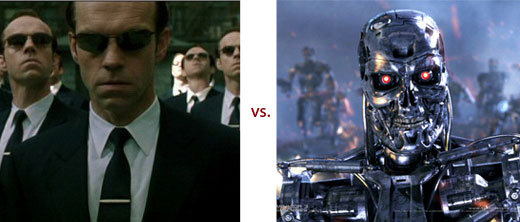
In place of Orwell’s 1984, I would suggest The Terminator. Though the original is 25 years old, James Cameron’s vision of a future controlled by oppressive technology embodied by Arnold Schwarzenegger is still common knowledge for most of us. The Governator clearly represents the worry of technological oppression from outside, and the heroes in the stories are concerned with preserving our humanity.
In place of Huxley’s Brave New World, an fun choice would be Wall-E, but it is not as ingrained in our culture and it’s message is almost too obvious. Instead, I think the Wachowski Brother’s The Matrix does a better job of portraying humans welcoming technological control. It’s hard to believe that this movie is already 10 years old, but who can forget the image of millions of humans living in pods connected to and powering the Matrix? Although the heroes in the story want to be freed from their oppressors, one of the movie’s great statements comes when the character Cypher (played by Joe Pantoliano) tries to betray the heroes for the chance to be reconnected to the Matrix and made unaware of the true reality of human suffering. He prefers to jettison his humanity for a false world of technological comforts.
Today and Tomorrow?
Cameron’s Terminator makes for great entertainment and a spooky vision of technology taking over the world through guns and metal. But just as Postman argued that Huxley’s portrayal of a technological takeover which is welcomed by humanity is more probably, I think that The Matrix offers a clearer portrait of the trajectory of today’s world.
For all the good our gadgets and social networks do, do we not feel at times as though they are taking over the best parts of our lives?
There is no Governator holding a gun to our heads shouting, “You must be checking the Twitt-ah every oww-ah!” Instead, we are the ones who find it hard to turn it all off. Have we not become just a little bit like Cypher in our desire to be connected all the time? Does this not betray how much we love our technology sometimes more than even our humanity?
The Image
Postman was of course not arguing that we should sit around wondering which future to fear. Instead he was using those visions of the future as a way of understanding our present. Similarly, our comparison of The Terminator and The Matrix is designed to help us ask good questions about where we are headed in our own lives.
Are we being fully human in a way that honors the image of God imprinted upon us? Do we use technology to glorify God through redeeming areas of human life or do we allow technology to slowly replace our God-given limitations? Are we tempted to live a life disconnected from the pain and difficulty of reality in favor of easy and fast electronic stimulation?
Which trajectory do you see yourself on? Can you think of a better illustration of our world?
John, thank you for this. I see both threads occurring simultaneously, with the gov’t (federal, state and municipal) and peer groups pressuring us to adopt technology to increase visibility while individuals generally just go along with it. Facebook is a great example. It is really hard now to just plain not have a facebook account or a cell phone and still keep up with people, as that is the defacto standard for most people to communicate. My grand mother had a facebook account before me.
The bulk of our presidents were born into homes without running water, and yet if you try to raise a child without running water now, CPS will yank your kids out of there for abuse/neglect. I really don’t see it as being very far off that cell phones and broadband are considered a fundamental human right guaranteed by the government. Finland just passed legislation making high speed internet a legal right.
For a lot of people, this is considered to be a good thing. I tend to view it is a significant danger if left unchecked and we do our best in our family to encourage the use of technology as an enhancement to normal life, rather than an outright replacement. I think those in technical fields are uniquely positioned to encourage this viewpoint, as they are expected to be the most connected and earliest adopters of these new tools. Doing so without regard to the long term impacts has the potential to dilute our influence and render our ministries impotent.
Your analogies (or revisitations of Postman’s) are appreciated, as is your insight. Thanks man.
-eli-
Eli, good to hear from you. I too thought Finland’s legislation was a bit strange. Most of the histories I’ve been reading talk about how in ancient times the secular world had no eschatology or belief that something better was coming in the future. Then Christianity came with it’s hope of a future made right by the return of Christ. As Christendom fades, the new secularism has co-opted the idea of a better future but put in the place of Christ, a hope that technology will bring an end to suffering and make all things right.
That’s probably not too big of a deal except when we Christians accidentally start believing in that same doctrine 🙂
It is sad and ironic that our updated analogies are themselves manifestations of the problems Postman was diagnosing.
Perhaps Postman’s analogies should be left as they are. What good are these newer analogies when they require compromising the very values that Postman demands?
I say let well enough alone and demand more of everyone–including literacy.
John, I understand your concern (especially in switching mediums), but I’m not sure its inherently bad to update illustrations every few generations.
I like your observation here. It’s helpful to keep Postman’s warning in our minds as technological advance continues hurtling us on our way.
“Check the Twitt-ah every oww-ah!”
The phraseology here is money. I will probably think this every time I use Twitter until the Machines overtake us.
On a related note, apparently Facebook can now act as a graveyard where you can visit the departed.
http://www.pcpro.co.uk/news/352807/facebook-to-preserve-accounts-of-the-dead
We already had online suicide notes. I guess this is just another move in that direction.
Jon,
Have you seen the latest issue of Adbusters? It is one of their contrasting issues, looking at ‘The Virtual World’ in one half and ‘The Natural World’ in the other. While in some ways I think Adbusters is a little extreme, sometimes I find their articles refreshing and cause me to wonder if the ‘alternative’ they are seeking to provide to some is more like the ‘alternative’ to what the church ought to be providing.
Much of what they cover in the articles in ‘The Virtual World’ deal with the runaway growth of technology and it’s impact on the way we live.